Explorer's Log: Octopus Dossier
A Study in Vision, Asset, and Legacy: The Discovery of the HMS Hood.
True exploration is not a voyage; it is an operation. It is the methodical application of a singular vision, enabled by a purpose-built asset and executed with strategic patience. Few cases embody this principle more completely than the late Paul Allen’s multi-year search for the wreck of the HMS Hood, a mission that culminated in 2015 with one of the most significant underwater discoveries of the 21st century.
To understand this achievement is to understand a fundamental shift in the potential of a private maritime asset. The story of this discovery is not merely a tale of finding a lost ship. It is a definitive case study in the modern potential of a private vessel to function as a platform for historical preservation, a testament to a principal's long-term commitment to a mission far beyond the scope of conventional yachting.
THE SYMBOL AND THE SCAR
To appreciate the mission's gravity, one must first appreciate the target. The battlecruiser HMS Hood was, for two decades, the largest and most powerful warship in the world. She was the embodiment of the Royal Navy's global prestige, a floating symbol of British sea power. Her loss on May 24, 1941, was a wound in the national psyche.
During a catastrophic engagement with the German battleship Bismarck in the Denmark Strait, a shell from the Bismarck is believed to have penetrated the Hood's aft magazine. The resulting explosion was apocalyptic, tearing the ship in two. She sank in less than three minutes. Of the 1,418 men aboard, only three survived. The event was a profound national trauma, and the wreck became a sacred maritime grave, its precise location a mystery guarded by some of the most treacherous waters on the planet [Royal Navy].
THE INSTRUMENT OF INTENT
A mission of this historical weight required an asset of unparalleled capability. The principal, Microsoft co-founder Paul Allen, was a man whose father had served in the US Army during WWII and who possessed a deep, personal interest in the history of that conflict. His approach was not that of a collector, but of a technologist—applying a problem-solving mindset and immense resources to challenges in science and historical discovery.
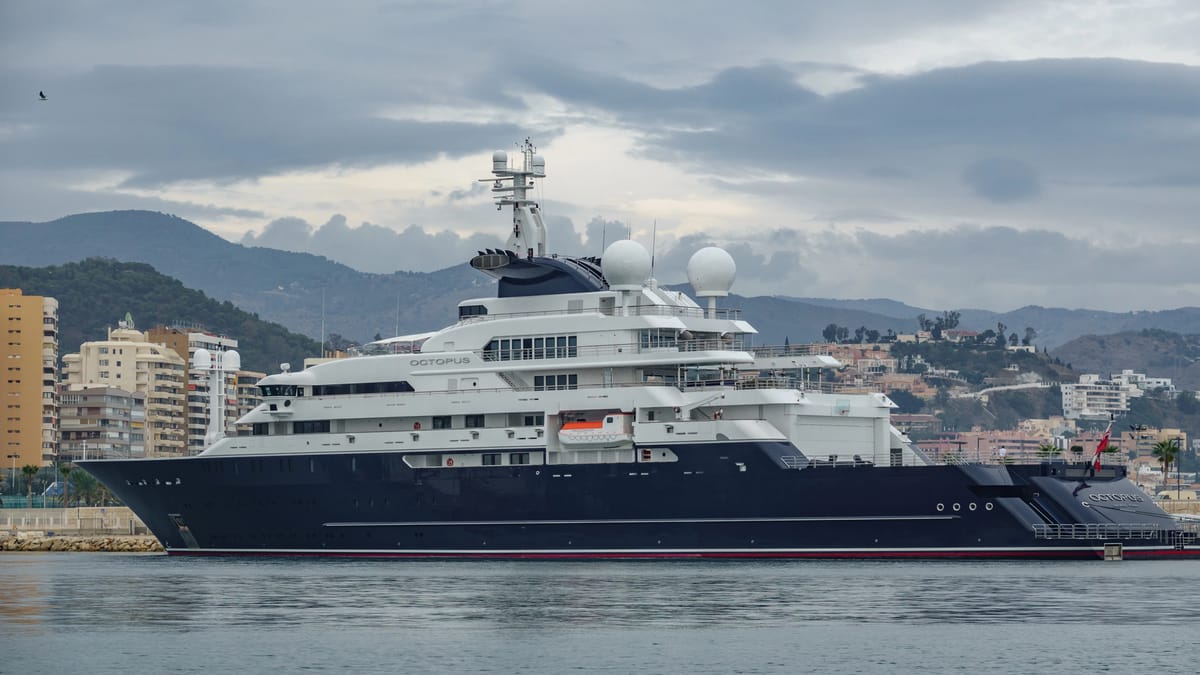
His vision required the M/Y Octopus. When launched by the esteemed German shipyard Lürssen in 2003, it was not simply a large yacht; it was a new class of vessel.
- The Platform: The 126.2-metre, Ice-Class 1A hull was engineered for a 12,500 nautical mile range, providing the endurance for true global autonomy. Its construction by Lürssen, a shipyard with a lineage of building the most complex and robust private vessels, ensured a level of engineering integrity essential for high-risk environments.
- The Core Technology: The centerpiece of its capability was an integrated, floodable stern dock. This protected internal bay allowed for the launch and recovery of its two most critical pieces of equipment in sea states that would be impossible for a conventional yacht:
- The Submersible Pagoo: A yellow, 8-person submarine capable of diving for up to eight hours, designed for direct, manned observation of the seabed.
- The ROV: A work-class Remotely Operated Vehicle, tethered to the mothership by a fiber-optic cable, capable of operating at depths exceeding 3,000 meters and equipped with high-definition, low-light cameras and two powerful, precise manipulator arms.
- The Ecosystem: The vessel was designed for total self-sufficiency. The interior, designed by Jonathan Quinn Barnett, was an ecosystem for long-duration missions. A cinema served as a high-resolution theatre for mission debriefings. A professional-grade recording studio was available for scientific narration. Even the glass-bottomed swimming pool and basketball court were strategic assets, providing essential outlets for the 42-person crew to maintain physical and mental fitness during prolonged and demanding expeditions.
Octopus was the physical manifestation of Allen's intent: a self-contained, deep-ocean research platform that provided the stability and endurance of a state-level research vessel, but with the agility of a private asset.
THE OPERATIONAL THEATRE
The Denmark Strait is a notoriously hostile environment. The confluence of the cold East Greenland Current and the warmer Irminger Current, combined with the funneling effect of the landmasses, creates violent, unpredictable weather and sea states.
Allen’s first attempt to locate the wreck in 2001 was unsuccessful. The mission was not abandoned, but placed on a strategic hold. This demonstrates a key lesson in the nature of true exploration: capital and technology are impotent without the discipline of patience. The successful 2015 operation was a model of methodical execution. Working with the full authorization of the UK Ministry of Defence, the team first used a towed side-scan sonar array to "mow the lawn"—a painstaking process of sending pulses of sound to the seabed to create a topographical map of a vast, pre-defined grid.
After days of this methodical survey, a debris field was identified that matched the signature of a catastrophic explosion. The Octo ROV was then deployed for visual confirmation. At a depth of 2,800 meters, in near-total darkness and under a crushing pressure of 4,100 PSI, the ROV's lights brought the twisted wreckage of the mighty warship into view for the first time in 74 years.
THE ACT OF RECOVERY & THE LEGACY
The mission’s primary objective, established in partnership with the HMS Hood Association, was not merely to find the wreck, but to recover its bell as a national memorial. The ROV located the bell, torn from the ship by the explosion and lying on the seabed. The recovery was a delicate act of remote surgery. The ROV pilots, operating from the control room aboard Octopus, had to use the manipulator arms to clear debris and attach a specially designed harness, a task requiring immense skill and precision.
The bell was carefully brought to the surface and, after a year of painstaking conservation, it was unveiled by Princess Anne. It is now the centerpiece of a memorial at the National Museum of the Royal Navy in Portsmouth, a tangible tribute to the 1,415 lives lost.
The discovery of the HMS Hood by the M/Y Octopus is the definitive proof of concept for the private expedition vessel as an instrument of legacy. It demonstrates that when a principal’s vision is matched with a correctly specified asset and a long-term strategic commitment, the result can transcend the world of private yachting and make a lasting contribution to history. It is the ultimate expression of craft and command.